

You Wrote This?
5 pieces that sound nothing like the composers who wrote them


Whenever I hear an unfamiliar piece on the radio, or land on something I don’t recognise in one of my Spotify playlists, my brain immediately starts trying to work out what it is. What period does it belong to? Is it Baroque, Classical, Romantic or something more modern? And, most importantly, who wrote it?
I particularly enjoy this game when there’s a singer involved, because then I can really show off to myself. With a famous singer, I can sometimes tell within a few notes. I wish I could do the same with instrumentalists. I’d love to hear from any instrumentalists reading this: how do you recognise a particular performer? Is it their style, their phrasing or the actual sound they make? And can anyone genuinely identify a conductor from an unknown recording? That feels like an elite level of classical musicianship to me.
But recognising music isn’t only a piece of trivia. It is also about knowing which musical world you have entered and what its rules might be. The more familiar I am with a piece, the more I can anticipate what is coming, and the more I notice what a performer does differently. A singer might extend a note slightly, lean into a particular word or pull the volume back where I wasn’t expecting it. Familiarity doesn’t make music less surprising. Quite often, it makes it more so.
This week, though, I’m interested in the opposite experience: pieces that don’t behave as expected. These are works that sound strangely unlike the composers who wrote them, whether because they come from very early in their careers, use an unusual combination of instruments or reveal a side of them we rarely hear. Had I encountered some of these without seeing the title, I would have had serious difficulty naming the composer. Let’s see how you do.
Piano Trio in G major - Claude Debussy
Debussy is usually associated with music that shimmers, shifts and never seems entirely settled. The word ‘Impressionism’ is often applied to him, although Debussy himself wasn’t particularly fond of it. A great example of this if his famous La Mer (The Sea), where the orchestra appears to move like water, constantly changing colour and shape. There may be melodies, but they rarely sit still for long enough to become the sort of tune you could easily hum. Listening to Debussy can feel a little like wandering through a dream in which everything is familiar but nothing quite follows the usual rules.
But Debussy wasn’t always Debussy, at least not the Debussy we recognise today. He wrote this Piano Trio in 1880, when he was 18 and working as a musical companion to Nadezhda von Meck, the wealthy patron best known for supporting Tchaikovsky. It sounds far more like a conventional piece of Romantic chamber music, with clear melodies, neat structures and a warm, flowing piano part. There are occasional hints of the composer he would become, but I might have guessed some other romantic composer long before Debussy. The manuscript was largely forgotten until it was rediscovered in 1982 and finally published in 1986, more than a century after it was written.
Adagio and Rondo in C minor, K. 617 - W. A. Mozart
Doing some research for this newsletter, I came across quite a few Mozart pieces that didn’t immediately sound like Mozart, but none threw me quite as much as this one. Even its title, Adagio and Rondo in C minor, feels rather dry for such a peculiar piece. ‘Adagio’ simply means that the opening section is slow, while a rondo is built around a main musical idea that keeps returning between contrasting episodes.
The strange, slightly ghostly sound comes from the glass harmonica, or glass armonica. Benjamin Franklin invented the instrument in 1761, arranging glass bowls of different sizes along a rotating spindle. The performer turns the mechanism with a foot pedal and touches the spinning rims with damp fingers, rather like running a wet finger around a wine glass.
Mozart wrote this piece in 1791 for Marianne Kirchgessner, a celebrated blind glass harmonica player, combining the instrument with flute, oboe, viola and cello. There is still plenty of Mozart in the balance and elegance of the writing, but the glass harmonica changes the entire atmosphere. It sounds delicate, uncanny and oddly futuristic, as though Mozart has wandered into somebody else’s century.
Crisantemi - Giacomo Puccini
Puccini mainly wrote operas, and not particularly restrained ones. He gave us La bohème, Madama Butterfly and Tosca: great surges of orchestral emotion, soaring voices and, more often than not, a dead heroine by the final curtain. So when I first heard Crisantemi, a short piece for string quartet, Puccini never crossed my mind. There are no voices, no stage and no enormous theatrical climax. It feels intimate, private and almost unbearably contained.
Crisantemi means ‘chrysanthemums’, flowers traditionally associated with mourning in Italy. Puccini wrote the piece in 1890 after the death of Amedeo di Savoia, Duke of Aosta, reportedly completing it in a single night. Once you know that, it becomes easier to hear Puccini in it. The strings sing as if they were voices, and the two main melodies return with the same aching directness that would later appear in his operas. In fact, Puccini reused some of the music in his opera Manon Lescaut a few years later. It may not sound like operatic Puccini at first, but the more I hear it, the more unmistakably his it becomes.
Petite messe solennelle - G. Rossini
Rossini is mainly remembered for comic operas such as The Barber of Seville, full of quick-fire words, increasingly frantic ensembles and music that bubbles like a bottle of champagne. What is particularly extraordinary is that he wrote his final opera, William Tell, when he was only 37, then largely withdrew from public composition despite living for almost another 40 years.
The Petite messe solennelle, or ‘Little Solemn Mass’, appeared in 1863, more than 30 years after Rossini had left the opera house behind. It is serious sacred music, but not quite as solemn or conventional as the title might suggest. The original version was written for 12 singers, 2 pianos and a harmonium, an unusually small and slightly eccentric combination. Rossini called it the last of his péchés de vieillesse, or ‘sins of old age’, and even addressed God at the end of the manuscript, wondering whether what he had written was truly sacred music or merely ‘sacred opera’. The racing comic energy has mostly disappeared, but his theatrical instincts haven’t. This is Rossini looking towards the next world while still keeping one foot firmly in the theatre.
Falstaff - Giuseppe Verdi
Verdi’s final opera, Falstaff, is unlike almost anything else he wrote. We tend to associate Verdi with political conspiracies, fathers and daughters, doomed lovers and heroines who rarely make it to the end alive. Falstaff, by contrast, is a comedy about an ageing, greedy and magnificently self-important knight who attempts to seduce 2 married women at once, only to discover that everyone around him is considerably cleverer than he is.
I thought for a long time it was Verdi’s only comedy but it wasn’t. That was Un giorno di regno, written more than 5
0 years earlier and received so badly that he never attempted another until Falstaff. Here, aged nearly 80, he produced music that feels quick, light and constantly in motion. I remember genuinely laughing aloud when I saw French Bass-Baritone Laurent Naouri in the title role at Glyndebourne, transformed by a well padded body suit (the singer has a rather slim figure) into a man almost as wide as his ego.
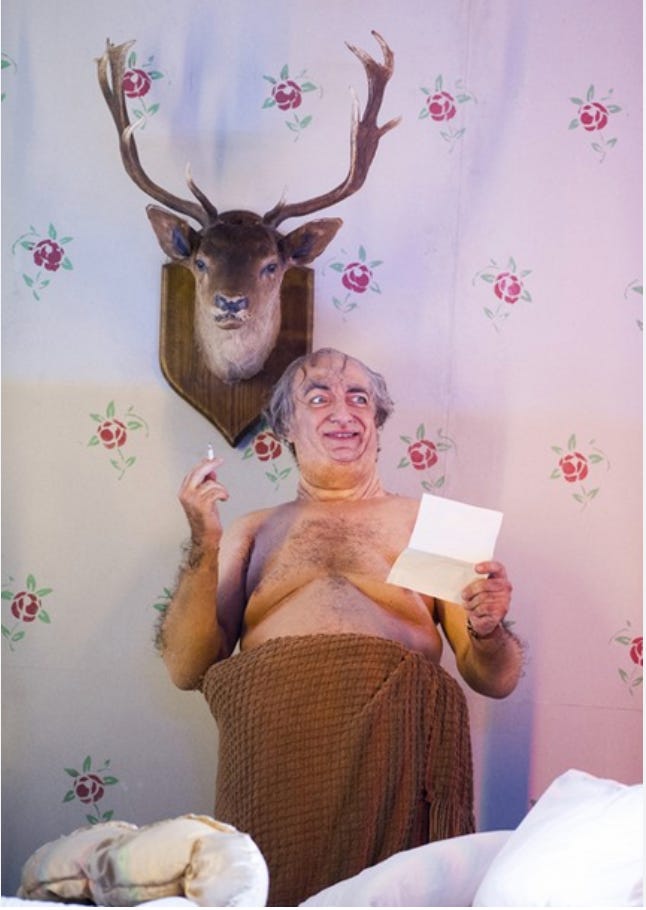
The strangest touch comes at the very end, when Verdi concludes the whole opera with a fugue. A fugue takes a musical idea and passes it between different voices, each entering in pursuit of the one before it. The word itself is connected to the Italian fuga, meaning ‘flight’ or ‘chase’. Verdi uses one of music’s most disciplined forms to tell us that everything in the world is a joke, and everyone is eventually made a fool. For a composer famous for tragedy, it is a wonderfully unexpected last word.
So perhaps the real test isn’t whether we can identify a composer within a few notes, but whether we’re willing to be surprised by them. Even the most familiar names still have corners of their music that don’t quite fit the story we’ve been told about them.
Have a great Sunday! x
Great article. I really enjoyed it. It makes one wonder why these composers went in a direction that differed from what made them successful. Boredom? The need for a challenge? Something else?
I would add 'Festive Overture' by Shostakovich to this list as well. I recently wrote an article about this piece, and mentioned how it is an outlier in his canon - so much of his work is drenched in dissonance, while 'Festive' is almost exclusively celebratory.